Start » State-of-the-Art » Maintenance Use Case
Fluid 4.0 establishes a digital standard for this purpose: Asset Administration Shells provide structured configuration, condition, and historical data throughout the entire life cycle. This enables quicker component replacement, reduced downtime, and significantly more efficient service processes.

Products are replaced when they reach the end of their service life—as part of preventive maintenance or due to failure. In the case of electromechanical and mechatronic products, this often raises the question of whether the settings are correct.
This information is frequently incomplete, scattered, or out of date. Data must be compiled manually in the event of malfunctions or maintenance and when components are replaced, the correct settings are often missing. Manufacturer-specific, non-standardized solutions cause media discontinuities between engineering, operations, and service, leading to delays and extended downtime. For plant and machinery, the focus is on high availability, reliability, and rapid restart in the event of a malfunction. This calls for a digital standard that provides structured access to condition, configuration, and historical data.
As part of its Fluid Power 4.0 initiatives, the VDMA Digitalization Working Group organized workshops with plant operators and service personnel to analyze work processes and identify tasks with high potential for optimization through digitalization. Maintenance was cited as a relevant use case, particularly for products that require configuration, such as control valves.
To reduce downtime, lengthy troubleshooting, and inefficient maintenance processes, relevant information regarding the condition, configuration, and history of fluid power components must be up-to-date and seamlessly available at all times.
Within the Asset Administration Shells of components and systems, condition, configuration, service, and error data can be structured and centrally provided using the “Parameterization Data” submodel. In the event of a malfunction or during maintenance, this information can be retrieved without media discontinuities and, if necessary, applied directly to replacement components. This eliminates the need for manual data searches, prevents incorrect configuration, and significantly reduces downtime.
A VDMA white paper has been published on the “Configuration Data” submodel, and its standardization has been initiated within the IDTA.
The use case delivers added value for all stakeholders along the value chain. The “Configuration Data Files” submodel standardizes and provides up-to-date condition, configuration, and historical data in a consistent manner.
Those responsible for the plant and service personnel can easily adopt the settings and apply them to new products. This reduces downtime, eliminates the need for manual coordination and prevents incorrect configuration, resulting in faster service processes, higher system availability, and improved data reusability.
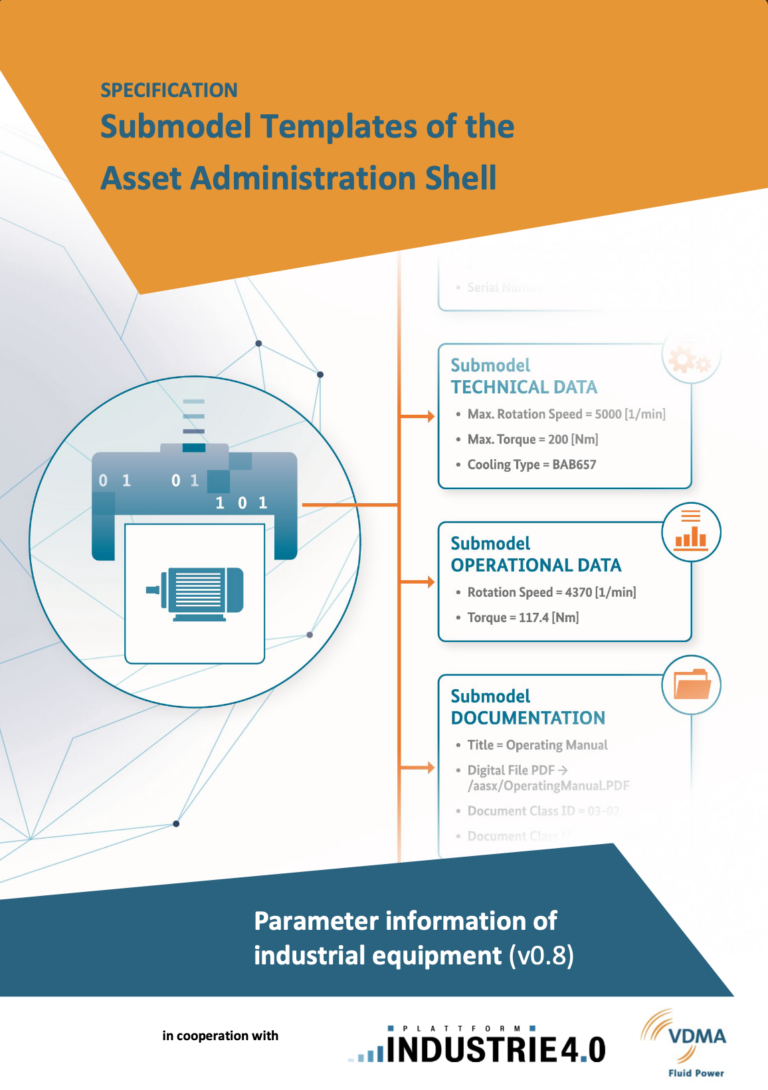
Components and systems are equipped with a digital twin in the form of an Asset Administration Shell. Condition monitoring is integrated into the Asset Administration Shell through the “Configuration Data Files” submodel. This allows condition, configuration, service, and error data to be captured in a structured format and provided centrally.
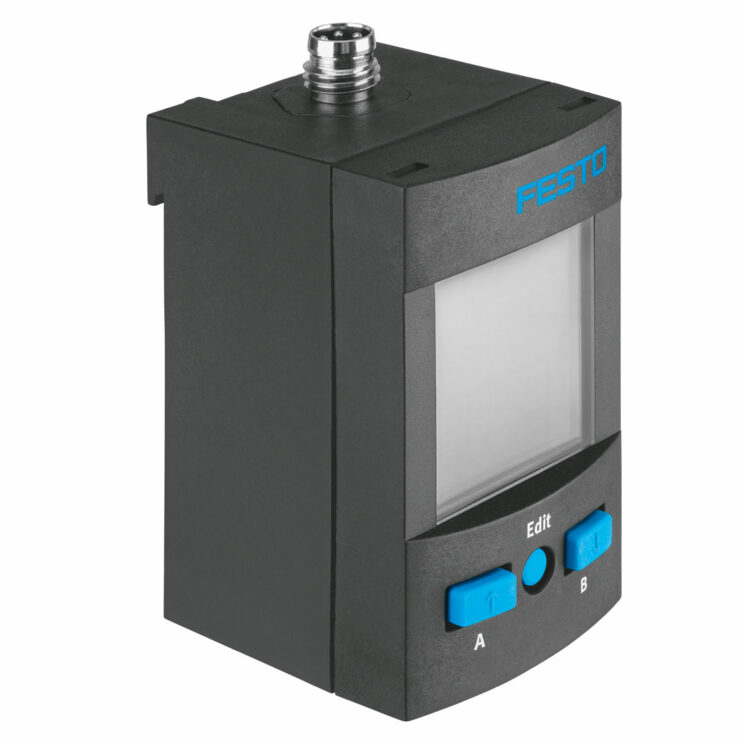
Using selected fluid power products as examples, we demonstrate how maintenance information is stored in a structured manner within submodels of the Asset Administration Shell. The examples are intentionally generalized so that the concepts shown can be applied to different products, systems, and workflows.