Manage Product Changes Digitally and Communicate Them Securely
Technical changes to components and systems are inevitable in fluid power. However, the way they are communicated determines efficiency, safety, and process stability.
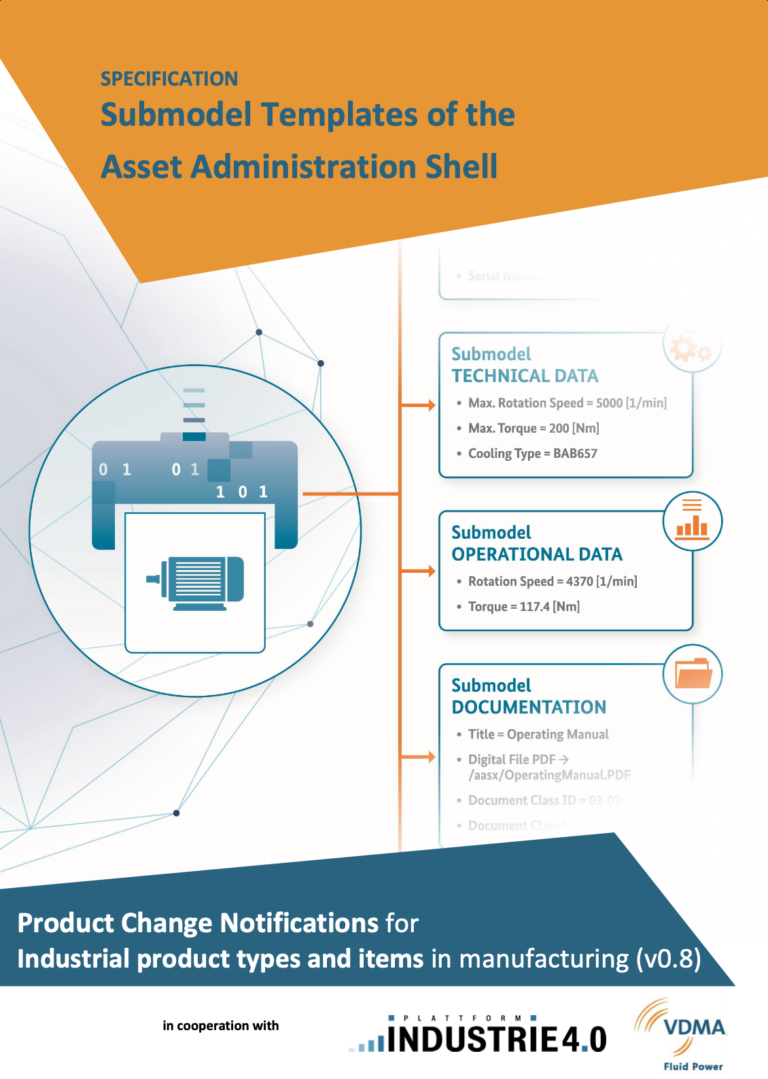
Fluid 4.0 demonstrates how change notifications can be provided across the entire value chain in a standardized, machine-readable, and traceable way using the Asset Administration Shell.
Initial Situation
Why Change Notifications Are Becoming a Challenge Today
As in other parts of the mechanical engineering industry, product changes occasionally occur in fluid power. The structured communication and proper interpretation of these changes pose significant challenges for many companies. Change notifications are often created in different formats and distributed through various channels. There is no standardized feedback mechanism to confirm whether and how changes have been implemented. Recipients must manually check and evaluate the information and transfer it into their own systems. This takes time and increases the risk of errors. This can have serious consequences, particularly for safety-relevant or quality-critical components. The lack of a consistent, digital standard limits transparency, traceability, and efficiency along the value chain.
Key Pain Points in the Industry
Lack of standardized product data and documentation
Significant time and cost pressures due to inconsistent information
Media discontinuities between manufacturer data, order specifications, and actual field conditions
Effort required for identifying and accessing operating and spare parts data
Submodel of the AAS
How Structured Data Improves Change Management Processes
As part of its Fluid Power 4.0 initiatives, the VDMA Digitalization Working Group organized workshops to identify the pain points and expectations of production planners who deal with change notifications on a daily basis. When problems arise, they are usually information-related issues that can be resolved—or even prevented altogether—with better, more targeted data.
The relevant information—such as the date and type of change or the impact on the customer—was identified, and additional requests were recorded.
Attributes were defined for this data, communicated to the ECLASS working groups for standardization, and submitted to the IDTA as a proposed submodel.
Greater Transparency and Efficiency for Manufacturers, Operators, and Partners
Digital change notifications deliver added value for all stakeholders along the value chain. The “Change Notification” submodel in the Asset Administration Shell enables information to be provided more quickly, more securely, and in a more targeted manner. As a result, companies are able to reduce manual work, avoid errors, and increase transparency throughout the entire change process.
Benefits for Manufacturers
Consistent creation and distribution of change notifications
Reduced communication and coordination effort
Benefits for Customers and Operators
Full and complete information
Better assessment of the impact on operations and service
Fewer production risks due to missing or delayed information
The “Change Notification” submodel in the Asset Administration Shell enables a seamless, digital process for the structured capture, transmission, and processing of technical changes along the entire value chain. Change information is no longer distributed as unstructured documents, but is provided in a standardized, machine-readable format that can be used across systems.
Manufacturers record changes once in a centralized location. This information is automatically forwarded to customers, suppliers, and internal systems via the Asset Administration Shell. Media discontinuities are eliminated, as the data can be transferred directly into ERP, PLM, or QM systems.
Recipients receive change notifications early, in full, and in a traceable format. Feedback on implementation status can be recorded digitally, creating transparency and significantly reducing the need for coordination. Consequently, the use case enables secure, efficient, and scalable communication of changes.
Using selected fluid power products as examples, we demonstrate how change notification information is stored in a structured manner within submodels of the Asset Administration Shell. The examples are intentionally generalized so that the concepts shown can be applied to different products, systems, and workflows.
Interested in the Solution or a Further Discussion?
Fluid 4.0 thrives on collaboration between industry, research, and end users. If you’d like to learn more, get involved, or share your own ideas, we look forward to hearing from you.